

Getting a personal loan with adverse credit in Australia is possible, but your options are narrower, and specialist lenders will typically charge higher rates than mainstream banks. A loan rejection because of adverse credit is a stressful moment, and many Australians face it without fully understanding what is on their credit file or what they can do about it. This guide explains what adverse credit means, how it affects your application, what lenders actually assess, and what practical steps may help you improve your credit score for loan approval before you apply again.
What Is Adverse Credit and Why Does It Matter?
Adverse credit refers to negative information on your credit report that signals financial risk to lenders. In Australia, your credit file is managed by two major credit reporting bureaus: Equifax and Experian. Either bureau may hold information that is pulling your score down. For a plain-English overview of how credit scores work, the MoneySmart guide to credit scores and credit reports is a useful starting point.
Common examples of adverse credit listings include:
- Defaults: a debt of $150 or more that was overdue for 60 or more days and listed by a credit provider
- Late or missed repayments recorded under comprehensive credit reporting rules
- Court judgments related to unpaid debts
- Excessive credit enquiries made in a short period
- Bankruptcy or Part IX debt agreements
These listings do not just reduce your credit score. They tell a lender that there is a history of difficulty meeting financial commitments, which makes them less willing to extend new credit.
The impact of adverse credit on a loan application is direct. Most mainstream banks and credit unions will automatically decline applications once they see certain negative listings. This is why understanding exactly what is on your file matters before you apply anywhere.
Can You Get a Personal Loan With Adverse Credit in Australia?
The short answer is yes, in some cases. However, the type of loan and the lender you can access will be different from what someone with a clean credit file can access.
Specialist and Non-Bank Lenders
A growing number of non-bank lenders and specialist lenders in Australia will consider bad credit personal loan applications. These lenders typically assess a broader picture of your finances, including your current income, employment stability, and expenses, rather than relying solely on your credit score.
The trade-off is that these loans almost always carry higher interest rates and fees than standard personal loans. This reflects the additional risk the lender is taking on. Before accepting any offer from a specialist lender, compare the comparison rate, not just the advertised interest rate, as fees can significantly increase the true cost.
Secured vs Unsecured Loans
If you own an asset such as a vehicle, you may be able to access a secured loan even with adverse credit. Because the lender has collateral to recover if you default, they carry less risk. Unsecured personal loans with adverse credit are harder to obtain and more expensive when you can find them.
What Loan Rejection Due to Adverse Credit Tells You
A loan rejection because of adverse credit is not a final answer. Each lender sets its own credit criteria, and what disqualifies you at one lender may be acceptable at another. However, multiple applications in a short period each generate a hard credit enquiry, and those enquiries themselves become visible on your credit file and can lower your score further. It may be worth applying selectively rather than broadly.
What Lenders Look at Beyond Your Credit Score
A credit score is an important factor, but most lenders also assess:
- Income stability: regular, verifiable income from employment, self-employment, or government payments
- Debt-to-income ratio: how much of your income is already committed to existing debts
- Employment history: length of time in current role and employment type
- Rental or mortgage payments: whether you have a consistent track record of meeting housing costs
- Bank statement behaviour: patterns of income, spending, and account management over 90 days
This means that even with adverse credit, loan options still exist if your current financial behaviour tells a more positive story. A lender who sees stable income, low existing debt, and responsible account use may be willing to look past an older listing that no longer reflects your situation.
How Long Does Adverse Credit Stay on Your File in Australia?
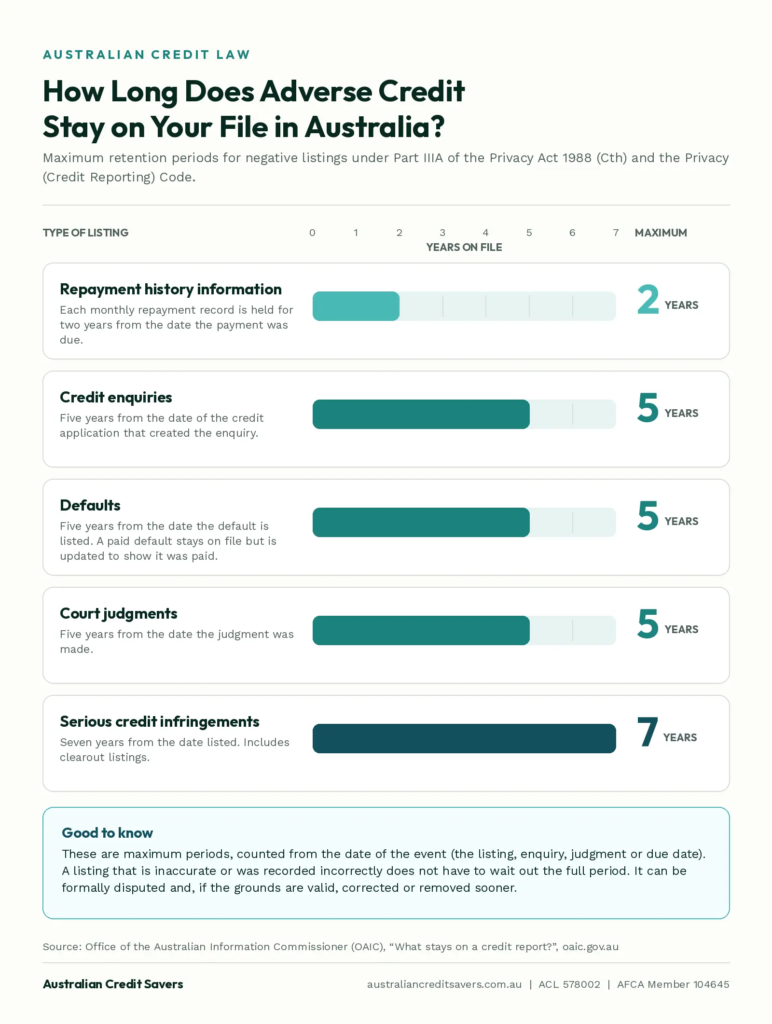
The length of time a negative listing remains on your Australian credit report depends on the type of listing:
- Defaults: five years from the date they are listed
- Court judgments: five years from the date of judgment
- Serious credit infringements (including clearout listings) seven years
- Repayment history information: two years
- Credit enquiries: five years
These timeframes are set under Part IIIA of the Privacy Act 1988 (Cth) and the Privacy (Credit Reporting) Code, both overseen by the Office of the Australian Information Commissioner (OAIC). Once the relevant period expires, the listing must be removed from your credit file. However, if the listing contains errors or was recorded incorrectly, it does not need to wait out the full timeframe. Inaccurate listings can be disputed and removed sooner if the grounds are valid.
Will Fixing My Credit Report Help Me Get Approved for a Loan?
Addressing inaccurate or invalid listings on your credit file is one of the most practical steps you can take before applying for credit again. If a listing was recorded in error, by the wrong creditor, in breach of National Consumer Credit Protection Act 2009, or based on information that was never properly notified to you, it may be eligible for dispute.
Credit repair before applying for a loan is a strategy worth considering carefully. Having an incorrect default corrected or a disputed court judgment resolved may improve the credit file a lender sees when they pull your report. Each bureau calculates scores using its own model, so a score can move in either direction after a listing changes. Even so, a more accurate file gives a lender a fairer picture of your position. In some cases, that may be the difference between a decline and an approval, or between a high-rate specialist loan and a more competitive mainstream product.
Realistic expectations matter here. Not every negative listing can be challenged. Only listings that contain errors or were recorded in breach of legal requirements can be successfully disputed. A default that accurately reflects a genuine missed debt will stay on your file for its full retention period. However, any listing that should not be there does not belong on your file, and the law gives you the right to challenge it.
If you are unsure whether your file contains errors, a free credit assessment with Australian Credit Savers can help you understand what is on your file and whether any listings may be disputed. Our licensed team reviews defaults through our invalid default removal service, court listing errors through our court judgment dispute assistance, and unauthorised enquiries through our credit enquiry review service.
To learn more about who we are and how we work, visit our About Us page or return to the Australian Credit Savers homepage.
What Are My Options If I Have Been Declined for a Loan Due to Bad Credit?
If you have received a loan rejection due to adverse credit, here are the practical steps worth considering in order:
1. Get a copy of your credit report. You are entitled to a free copy of your credit report from Equifax and Experian once every three months. Request your report from both bureaus and check each one for errors, outdated listings, or information you do not recognise.
2. Check for disputable listings. If you find a candidate for invalid default removal, a listing recorded against the wrong person, or a repayment history entry that does not match your records, these can often be formally disputed through a licensed credit repair service or directly with the credit provider.
3. Dispute repayment history errors. Repayment history information recorded incorrectly can affect your score even if a debt was ultimately paid. Our repayment history dispute service can identify whether the information held by a bureau accurately reflects what actually happened.
4. You may want to pause new credit applications. Every hard credit enquiry adds to your file. While disputes are under way or your financial position is improving, it may help to hold off on new credit applications unless they are necessary. Many lenders read a cluster of enquiries in a short window as a sign of financial pressure, which can make your position harder.
5. Focus on positive financial behaviour where you can. Paying current bills and repayments on time helps build a track record of responsible account management. Lenders can see recent positive repayment behaviour even while older negative listings remain on your file.
6. Ask about credit-building options. Some Australians use a secured credit card or a small credit-builder loan with a responsible lender to build positive repayment history. Whether this suits you depends on your circumstances, and a licensed financial adviser can help you weigh it up. It generally makes more sense after disputed listings have been resolved, not before.
How Australian Credit Savers May Be Able to Help
Australian Credit Savers (ACS) is a nationally licensed credit repair and credit report dispute service. ACS holds Australian Credit Licence (ACL) 578002, issued by the Australian Securities and Investments Commission (ASIC), and is a member of the Australian Financial Complaints Authority (AFCA), member number 104645. Disputes that cannot be resolved directly with a credit provider can be escalated to AFCA, which provides free and independent dispute resolution. The Privacy Act 1988 and the Privacy (Credit Reporting) Code are overseen by the Office of the Australian Information Commissioner (OAIC).
ACS works by reviewing your credit file to identify listings that may have been recorded incorrectly or in breach of Australian consumer credit law. Where grounds exist, ACS formally disputes those listings with the relevant credit bureau and credit provider on your behalf.
ACS operates on a no win, no fee structure. A $330 non-refundable investigation fee is payable at the start of the process, which is credited toward the total service fee if you proceed. This fee covers the investigation of your file.
ACS holds a 5.0 rating across 323 Google reviews and has published case studies documenting credit score improvements for real clients. Past outcomes do not guarantee future results, and not every listing is eligible for dispute. However, if inaccurate information is hurting your ability to access finance, a free credit assessment with ACS gives you a clear picture of what is on your file and what can be disputed.
Call 1800 844 185 or book your free credit assessment online.
Frequently Asked Questions
Can I get a personal loan with adverse credit in Australia?
Yes, some specialist and non-bank lenders will consider applications from people with adverse credit. However, the interest rates are typically higher, the loan amounts are usually lower, and approval is not guaranteed. Your overall financial position, including income and existing debts, is also taken into account.
What is adverse credit and how does it affect my loan application?
Adverse credit refers to negative listings on your credit file, such as defaults, missed repayments, court judgments, or excessive enquiries. When a lender reviews your application, they check your credit report. Negative listings increase the perceived risk of lending to you and can result in a higher interest rate, reduced loan amount, or outright decline.
How long does adverse credit stay on my file in Australia?
Most negative listings remain on your Australian credit file for five years. Serious credit infringements can remain for seven years. Repayment history information is held for two years. If a listing is inaccurate or recorded in error, you do not have to wait for it to expire. It can be formally disputed and removed sooner if the grounds are valid.
Will fixing my credit report help me get approved for a loan?
Having inaccurate or invalid listings corrected on your credit file may improve your credit score. Each bureau calculates scores using its own model, so a score can move in either direction after a file changes. A more accurate file may also improve how a lender reads your application, which may increase your chances of loan approval or help you qualify for better loan terms. Only listings that contain errors or were recorded in breach of legal requirements can be successfully disputed. A licensed credit repair service can assess your file and advise on what may be eligible.
What are my options if I have been declined for a loan due to bad credit?
Start by obtaining a copy of your credit report from both Equifax and Experian. Check for errors and disputable listings. Consider working with a licensed credit repair service if you find inaccurate information. It may help to avoid applying for multiple loans in a short period, as each application creates a hard enquiry. Focus on demonstrating positive financial behaviour while any dispute process is under way.
Does Australian Credit Savers guarantee results?
No. Australian Credit Savers does not guarantee outcomes. ACS identifies listings that may be eligible for dispute under Australian credit law and pursues those disputes on your behalf. Whether a listing is successfully removed depends on the specific circumstances of each case. Past outcomes documented in ACS case studies do not guarantee the same result for every client.
Key Takeaways
- Getting a personal loan with adverse credit in Australia is possible through specialist lenders, but interest rates are higher and approval is not guaranteed.
- Adverse credit listings include defaults, missed repayments, court judgments, and excessive enquiries. Most remain on your file for five years.
- Lenders assess more than your credit score. Income, employment stability, and bank statement behaviour all influence the decision.
- Inaccurate or invalid listings can be formally disputed and do not need to wait out the full five-year period.
- Multiple loan applications in a short period can worsen your position by adding hard enquiries to your file.
- Australian Credit Savers offers a free credit assessment and operates on a no win, no fee structure, with a $330 investigation fee disclosed upfront.