
Learning how to build credit from scratch in Australia starts with one manageable account, light use, and on-time payments every month. Under Australia’s Comprehensive Credit Reporting (CCR) system, every repayment on time is recorded as positive data lenders can see, and most people start showing a real score within three to six months. Whether you are a new resident, a young adult, or starting fresh after a setback, this guide covers the right products to open first and the habits that keep your file moving forward.

Why Having No Credit History in Australia Is a Problem
Most people assume that having no credit history is neutral. In practice, lenders treat a blank credit file almost the same way they treat a poor one. When a bank pulls your credit file and finds nothing, they cannot assess your risk. Their response is usually caution: higher rates, lower limits, or a flat refusal.
The irony is frustrating. You need credit history to get credit, but you need credit to build credit history. That is the cycle this article helps you break.
According to MoneySmart, the Australian government’s financial guidance service, your credit score in Australia typically sits between zero and 1,200, depending on which credit reporting body has calculated it. A higher score means lenders consider you less risky, which translates to better loan approvals and lower interest rates. If your file is blank, you effectively have no score, which puts you at a disadvantage before any conversation with a lender has even started.
The good news: this problem is solvable, and it does not take years.
How the Australian Credit Reporting System Works
Before you can build a credit profile in Australia, it helps to understand what actually goes into one.
Australia operates what is called a Comprehensive Credit Reporting (CCR) system. This means your credit file contains both positive and negative data. It is not just a record of problems. Every time you pay a bill on time, that payment can be reported as a positive mark. Every time you miss one, that can be recorded too.
Your credit file is a document held by a credit reporting body. Australia has two main credit reporting bodies: Equifax and Experian (which acquired illion). These agencies collect data submitted by banks, lenders, telcos, and other credit providers, and each may hold slightly different information about you, which is why checking your report with both is worthwhile.
Your credit score is a number calculated from the information in your file. It is not a fixed number. It changes as new information is added. As a credit score beginner in Australia, understanding this distinction matters: you are not trying to unlock a single secret number. You are building a track record of consistent, responsible credit behaviour over time.
For a comprehensive overview of how the system works, the CreditSmart guide to credit reporting in Australia is worth bookmarking. CreditSmart is an initiative of the Australian Retail Credit Association and is a reliable, independent resource on credit reporting rights and responsibilities.
How to Build Credit From Scratch in Australia: 6 Proven Steps
These steps are ordered deliberately. Start at step one and move forward. Do not skip to a later step before your first account is active and running smoothly.
Step 1: Get Your Free Credit Report First
Before you open anything, know where you are starting. You are entitled to a free copy of your credit report from both Equifax and Experian once every three months. Requesting your own report is recorded as a soft enquiry and has no effect on your score.
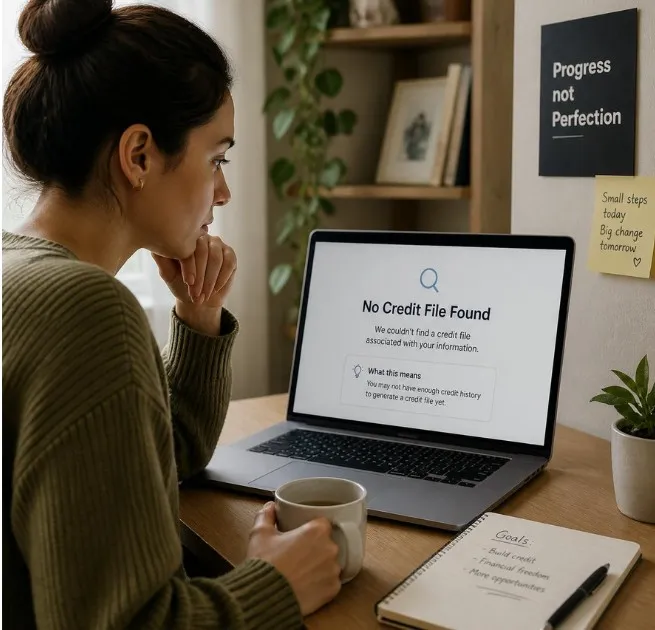
If your credit file is empty, you will receive a notice confirming that no file currently exists under your name. That is fine. It simply confirms your starting point.
If your file has old or incorrect entries, those need to be addressed before you begin building. Inaccurate listings can drag your score down unfairly even as you build new positive data. Our team at Australian Credit Savers specialises in identifying and disputing incorrect listings on your credit file, including unauthorised credit enquiries that you may not even know are there.
Step 2: Open a Low-Limit Credit Card
A credit card with a low limit is the most accessible and effective first product for anyone starting their credit file in Australia for the first time. Choose a card with no annual fee or a low one, and set the limit as low as the bank will allow. You are not using this card to spend more. You are using it to demonstrate that you can borrow and repay responsibly.
Use the card for one or two small recurring expenses each month, such as a streaming subscription or your weekly groceries. Then pay the balance in full before the due date. Every on-time repayment goes onto your file as a positive mark. Over three to six months, those marks accumulate into a visible, positive credit score.
Do not apply for multiple credit cards at once. Each application triggers a hard enquiry on your file. A cluster of hard enquiries in a short period signals financial stress to lenders and can hurt a thin file significantly more than it would hurt an established one.
Step 3: Consider a Small Personal Loan
If a credit card is not the right fit for you, a small personal loan is another valid starting point. Some Australians prefer the structure of a fixed monthly repayment over the flexibility of a credit card, and that discipline can work in your favour.
A secured personal loan, where your savings or an asset back the borrowing, carries less risk for the lender and is often more accessible for someone with no established file. Once the loan is in place, every repayment you make on time adds to your positive payment history.
Step 4: Use a Postpaid Mobile Phone Contract
Many Australians do not realise that a mobile phone contract is often enough to create your first credit file entry. When you sign up for a post-paid mobile plan, the telco typically conducts a credit check. That check creates your file. Once your account is active, your payment history may be reported to a credit reporting body.
This step alone will not build a strong credit score, but it is a low-friction way to get your credit file created while you set up a more substantial credit product.
Step 5: Pay Every Bill on Time, Every Time
This is the single most important habit once you have credit products active. Under Australia’s CCR system, lenders can see 24 months of your repayment history. On-time payments build a positive track record. Late payments create negative marks that can remain on your file for up to two years.
Set up automatic direct debits for the minimum repayment on every credit account. Then manually pay the full balance before the statement due date. The automatic payment protects you from accidental missed payments. The manual top-up protects you from interest charges.
This combination, automatic safety net plus full repayment, is the lowest-risk approach for anyone starting to build a credit profile in Australia.
Step 6: Keep Your Credit Utilisation Low
Credit utilisation refers to how much of your available credit you are using at any one time. If your card limit is $2,000 and your balance is $1,800, your utilisation is 90%. High utilisation signals financial strain to lenders, even if you are paying on time.
As a general guide, keeping your balance below 30% of your credit limit is considered healthy. For a $2,000 card, that means keeping your running balance below $600. If you need to spend more in a given month, pay the card off mid-cycle before your statement closes rather than letting a high balance be recorded.
Common Mistakes That Slow Down Credit File Growth in Australia
Even with the right products in place, these habits can stall or reverse your progress.
● Applying for multiple credit products at once. Each hard enquiry reduces your score temporarily. Space applications at least three to six months apart.
● Closing your oldest account. Length of credit history matters. Keep your first account open even if you rarely use it.
● Missing payments, even small ones. A single missed payment creates a repayment history mark that stays on your file for two years. Automate your repayments.
● Maxing out your credit limit regularly. High utilisation hurts your score even when you pay in full. Spread spending across the month or pay mid-cycle.
● Ignoring your credit file for months at a time. Check your report every six months to catch errors early. Incorrect listings are more common than most people realise.
How Long Does It Take to Build a Credit Score in Australia?
Most people who start from a blank credit file in Australia begin to see a score appear within three to six months of opening their first account and making regular on-time payments. The score will be modest at first, typically sitting in the fair or average band.
Moving from fair to good usually takes another six to twelve months of consistent positive behaviour. Reaching very good or excellent typically requires 18 to 36 months of clean payment history across more than one type of credit product.
There is no shortcut that is safe. Products that claim to artificially inflate your score are not legitimate. Patience, consistency, and accurate data on your file are the only reliable levers.
What to Do If Your Credit File Has Errors
Building a positive credit history is much harder when your file already contains incorrect or unfair negative listings. These can include credit enquiries you never authorised, defaults recorded in error, or repayment history that does not accurately reflect what happened.
Under Australian consumer credit law, you have the right to dispute incorrect information on your credit file. You can lodge a dispute directly with the credit reporting body, directly with the lender who submitted the information, or through the Australian Financial Complaints Authority (AFCA), which is the free, independent dispute resolution service for financial complaints in Australia.
Many people find the dispute process confusing and time-consuming, particularly when a lender and a credit reporting body disagree on what was reported. That is where licensed credit repair professionals can help.
At Australian Credit Savers, we hold Australian Credit Licence (ACL) 578002 and are AFCA members (membership number 104645). We review your credit file in detail, identify any entries that may be incorrect or disputable, and manage the dispute process on your behalf. Our services include Invalid Default Removal, Credit Enquiry Review and Dispute, Repayment History Dispute Resolution, and Court Judgment Dispute Assistance, among others.
Past outcomes do not guarantee future results. Results depend on the individual circumstances of each client’s credit file.
When Building Credit Is Not Enough: Addressing Existing Negative Listings
Starting fresh is straightforward when your credit file is truly empty. It becomes more complex when you are trying to build new positive data while old negative listings are still active on your file.
A default listing can remain on your credit file for five years from the date it was recorded. A court judgment can remain for five years. Even if you spend the next 12 months making every repayment on time, those listings will continue to weigh on your score until they are removed or age off naturally.
If you believe any existing listing is incorrect, outdated, or was recorded without following the proper legal process, you may have grounds to dispute it. That is not the same as simply not wanting it there. It requires a genuine factual or procedural basis.
Our team at Australian Credit Savers reviews your file at no upfront cost and provides an honest assessment of which listings, if any, may be disputable. Explore our full range of credit repair services to understand what we can assess for you.
Take the First Step Toward a Stronger Credit File Today
Whether you are working to build credit from scratch in Australia or dealing with a credit file that already has problems, the most important step is to understand exactly what is in your file right now.
Australian Credit Savers offers a free credit assessment for Australians who want to understand their credit position and explore their options. Our licensed team will review your file, explain what we find, and give you an honest picture of what is possible.
We hold Australian Credit Licence 578002, are AFCA members, and have earned a 5-star rating across more than 450 verified reviews on Google reviews, Product Review, and Trustpilot.. Two of our published client case studies document credit score increases from 447 to 811 and from 406 to 983 after our team successfully disputed incorrect listings on their files.
Past outcomes do not guarantee future results.
Ready to Find Out Where Your Credit File Stands?
Book your free credit assessment with Australian Credit Savers today. No obligation, no jargon, just a clear, honest review by a licensed credit repair team. We operate under a No Win, No Fee structure, with a $330 non-refundable investigation fee credited to your total cost if you proceed. Claim your free assessment here, or call 1800 844 185. Our licensed team is ready to help reach out, and we will be in touch to walk you through your options.
Frequently Asked Questions
Can I build a credit score in Australia with no credit history at all?
Yes. Starting from a blank file is actually simpler than starting from a file with negative listings. Open one manageable credit product, such as a low-limit credit card or a small personal loan, and pay it on time every month. Most people with no credit history in Australia begin to see a score appear within three to six months.
Does a postpaid mobile phone contract help build my credit score in Australia?
It can. Signing up for a post-paid mobile contract typically triggers a credit check, which creates your credit file if one does not exist. Your payment history may then be reported to a credit reporting body. On its own, a mobile contract generates a modest credit history. Pairing it with a credit card or personal loan builds your file more effectively.
How long do negative listings stay on my credit file in Australia?
Default listings remain on your credit file for five years from the date of recording. Court judgment listings also remain for five years. Credit enquiries typically remain on your file for five years from the date they were recorded, in line with the Australian Privacy Principles under the Privacy Act 1988. Repayment history entries remain visible for 24 months. If any of these are incorrect, you have the right to dispute them regardless of when they were recorded.
What is the difference between a credit file and a credit score in Australia?
Your credit file is the full record held by a credit reporting body, including your repayment history, credit applications, and any default or judgment listings. Your credit score is a number calculated from the information in that file. Your score changes whenever information is added to or removed from your file. Checking your file regularly helps you understand what is driving your score up or down.
Is it worth hiring a credit repair company when building credit from scratch in Australia?
If your credit file is genuinely empty, you can build it yourself by following the steps in this guide. Where a licensed credit repair service adds real value is when your file already contains negative listings that may be incorrect or disputable. Attempting to build positive credit on top of incorrect negative data is significantly harder. Australian Credit Savers operates on a No Win, No Fee basis, with a $330 non-refundable investigation fee that is credited toward your total cost if you proceed. A licensed credit repair expert reviews your file and identifies whether any existing listings can be disputed, which gives your new positive data a cleaner foundation to build on.
Key Takeaways
● A blank credit file is treated similarly to a poor one by most lenders; start building yours as early as possible.
● Under Australia’s Comprehensive Credit Reporting system, every on-time payment generates positive data visible to lenders.
● A low-limit credit card, used lightly and paid in full each month, is the most accessible starting point for anyone building their credit file in Australia for the first time.
● Avoid applying for multiple credit products at once; each hard enquiry temporarily reduces your score and is disproportionately harmful to a thin file.
● Incorrect listings on your file, such as unauthorised enquiries or invalid defaults, need to be disputed before you build on top of them.
● Most people starting from scratch in Australia see a meaningful credit score within three to six months of consistent on-time payments.