
Yes, you can get debt consolidation loans with bad credit, lenders will approve, since bad credit does not automatically rule you out. Lenders weigh your income, employment stability, recent repayment behaviour, and total debt alongside your credit history, so a poor file is only part of the picture. Our licensed credit repair experts at Australian Credit Savers see this every day, and reviewing your credit report before you apply can open up options you may not know you have.
What Is a Debt Consolidation Loan?
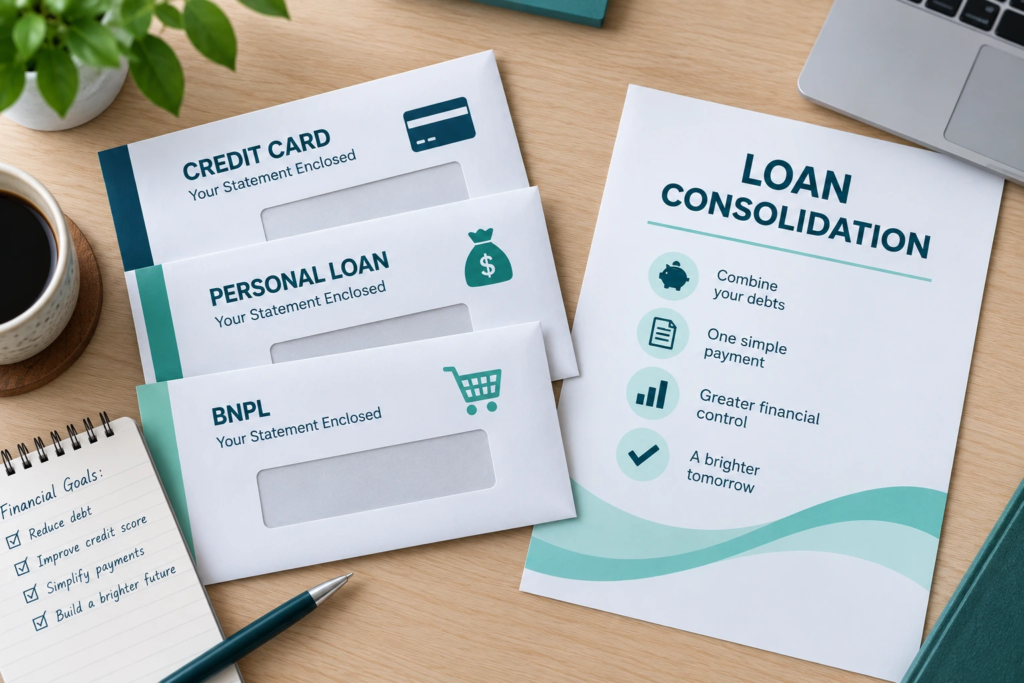
A debt consolidation loan combines multiple debts into a single loan, replacing separate repayments to different lenders with one repayment to one lender, usually at one interest rate.
For many Australians, the biggest benefit is not necessarily paying less interest. It is making debt easier to manage. Consolidation does not reduce what you owe. Instead, it restructures existing debts into a new loan with its own repayment schedule and terms.
Common debts people consolidate include credit cards, personal loans, buy now pay later (BNPL) balances, and overdue utility accounts. Whether it suits you depends on your current rates, terms, and overall position. According to Moneysmart, the Australian Government’s financial guidance service, consolidation can cost more overall if the new loan runs longer than your existing debts would have, even when the monthly repayment looks smaller.
Can You Get Debt Consolidation Loans With Bad Credit? Which Lenders Will Approve You?
Yes, bad credit does not automatically prevent you from accessing a debt consolidation loan in Australia. Lenders assess several factors when reviewing an application, and your credit history is only one part of the picture. This is the most common question people ask, and in most cases, having bad credit does not rule you out.
Lenders typically review a combination of factors, including:
- Income and employment stability
- Current living expenses and committed outgoings
- Existing loan repayments and credit limits
- Recent repayment history, particularly the last 12 to 24 months
- Total debt levels relative to your income
- Information recorded on your credit report
For example, someone who experienced financial hardship several years ago but has since maintained steady employment and consistent repayments may be assessed differently from someone still regularly missing payments today. Context matters, and lenders differ in how heavily they weigh each factor.
That said, bad credit does affect your options. You may be offered a higher interest rate to reflect the lender’s perceived risk, or asked to provide extra evidence of your ability to repay. Understanding this before you apply helps you make a more informed decision about debt consolidation with bad credit Australia lenders are likely to offer you.
When Does Consolidating Debt with Bad Credit Make Sense?
Debt consolidation is often worth considering when managing multiple monthly repayments has become difficult to track or sustain.
Circumstances where it tends to be a practical option include:
- You have repayments going to multiple lenders and find it hard to keep track
- You are paying high interest on credit card debt and a consolidation loan offers a lower rate
- You want a defined repayment schedule with a clear end date
- Your cash flow would genuinely benefit from a lower combined monthly repayment
- You have already addressed the underlying issues that led to the debt
However, consolidation is not always the right answer. If your budget is already stretched, or you are relying on credit to cover everyday expenses, taking out another loan without addressing the underlying issue may only provide temporary relief. It could leave you worse off if you continue to add debt on top of the accounts you have consolidated.
Consolidation works best as a restructuring tool, not a substitute for addressing income and spending patterns. If you want to consolidate debt bad credit history has made harder to manage, this distinction matters more than the headline interest rate.
Why Debt Consolidation Loans With Bad Credit Repayments Can Still Cost More
This is one of the most important things to understand before applying. A reduced monthly repayment can look attractive, but if the loan term is longer, you may end up paying significantly more interest overall.
Here is an illustrative example. A credit card of $8,000 at 21% p.a. (about $245/month), a personal loan of $10,000 at 14% p.a. (about $273/month), and a BNPL balance of $2,000 with ongoing fees add up to roughly $608 a month across three repayments.
A consolidation loan of $20,000 at an illustrative 15% p.a. over five years might bring that down to around $476 a month. Saving over $100 a month sounds appealing, but if the new loan runs longer than your existing debts would have, you could pay more interest over its life. Always compare the total repayment amount, not just the monthly figure, along with establishment fees, ongoing fees, early exit penalties, and whether the rate is fixed or variable.
How Much Can the Interest Rate Affect What You Pay?
Interest rates on debt consolidation loans for people with bad credit vary based on your credit history, income, existing commitments, and the lender’s own assessment criteria. The rate you are offered may differ significantly from the advertised comparison rate, particularly if you are looking at a bad credit personal loan rather than a standard consolidation product.
To illustrate, on a five year, $20,000 loan the monthly repayment is roughly $445 at 12% p.a., $486 at 16% p.a., and $530 at 20% p.a. These figures are illustrative only, exclude lender fees, and cover principal and interest repayments only. The gap between a 12% and 20% rate works out to roughly an extra $85 a month, or more than $5,000 over a five year term, which is why checking your credit report for inaccuracies matters before you apply.
How Much Can the Interest Rate Affect What You Pay?
Interest rates on debt consolidation loans for people with bad credit vary based on your credit history, income, existing commitments, and the lender’s own assessment criteria. The rate you are offered may differ significantly from the advertised comparison rate, particularly if you are looking at a bad credit personal loan rather than a standard consolidation product.
To illustrate, on a five year, $20,000 loan the monthly repayment is roughly $445 at 12% p.a., $486 at 16% p.a., and $530 at 20% p.a. These figures are illustrative only, exclude lender fees, and cover principal and interest repayments only. The gap between a 12% and 20% rate works out to roughly an extra $85 a month, or more than $5,000 over a five year term, which is why checking your credit report for inaccuracies matters before you apply.
How to Improve Your Chances of Approval Before Applying
If you are planning to apply for a debt consolidation loan with bad credit, there are steps you can take beforehand that may improve your position before a lender even reviews your file.
1. Review your credit report first. You are entitled to a free copy every three months from Australia’s credit bureaus, Equifax and Experian.
2. Check for errors or outdated listings. Mistakes, duplicate defaults, or incorrectly reported information can unfairly affect your credit profile and are worth investigating.
3. Bring repayments up to date where possible. Recent repayment history is often weighted heavily by lenders, and even a few consistent months can help.
4. Avoid multiple credit applications at once. Each one generates a credit enquiry, and several in a short period can signal financial stress.
5. Understand your actual budget. Work out what you can realistically afford before applying, so you can assess whether consolidation is genuinely sustainable.
For a full breakdown of what to check and how to compare offers, Moneysmart’s guide to debt consolidation and refinancing is a useful independent reference.
If you identify listings on your credit report that appear incorrect, such as defaults you were not properly notified about, accounts that do not belong to you, or information that does not comply with Australian credit reporting requirements, our Invalid Default Removal service and Credit Enquiry Review & Dispute service may be able to help before you apply.
What to Expect After You Apply for a Debt Consolidation Loan
The application process typically involves five stages, outlined below, so you know what to expect.
1. Application submission. You provide personal details, employment information, income verification such as payslips or bank statements, and details of the debts you want to consolidate.
2. Credit assessment. The lender runs a credit check, generating a credit enquiry on your file, and reviews your report alongside your income and expenses.
3. Conditional approval or decline. Some lenders offer conditional approval subject to document checks; others decline if your profile falls outside their criteria, since risk appetites differ.
4. Settlement of existing debts. If approved, the new lender usually pays out your existing debts directly, though funds are sometimes transferred to you instead.
5. Repayment begins. Repayments usually start the following month. Set up a direct debit from the outset to avoid missed payments.
If declined, ask the lender for the specific reason. This helps you decide what to address before applying elsewhere, and avoids multiple applications in quick succession.
What's on an Australian Credit Report, and Why It Matters for Consolidation
Before applying for any new credit, it helps to know what Australian credit reports contain. Under Part IIIA of the Privacy Act 1988 and the Privacy (Credit Reporting) Code, reports can include credit enquiries, current and closed accounts, repayment history over the past 24 months, defaults of $150 or more listed after required notice, court judgments, serious credit infringements, and personal identification details.
Some of this reflects positive financial behaviour. Other entries may limit your options. Critically, your credit report should also be accurate. Mistakes, outdated information, or incorrectly listed defaults can sometimes create unnecessary barriers when applying for finance, and these are situations where a licensed credit repair Australia clients can trust may be able to help.
The Office of the Australian Information Commissioner (OAIC) and the Australian Financial Complaints Authority (AFCA) both oversee different parts of how credit information is handled and disputed. If a dispute with a credit provider cannot be resolved directly, AFCA offers a free, independent complaints service for consumers.
Where Credit Repair Fits Into the Process
Reviewing your credit file ahead of a consolidation application can reveal more than what is there. It can show whether what is listed is actually accurate.
Australian Credit Savers helps clients identify listings that may warrant investigation, including incorrect or duplicate defaults, defaults listed without proper notice, outdated information, errors in personal details, and accounts or enquiries that do not belong to them.
Not every listing can or should be disputed, and no legitimate credit repair company will promise otherwise. But if information has been reported incorrectly or does not comply with Australian credit reporting requirements, it may be possible to have it reviewed and corrected, including through our Repayment History Dispute Resolution and Court Judgment Dispute Assistance services where relevant.
Past outcomes do not guarantee future results. Every credit file is different, and all decisions about credit listings remain with the relevant credit providers and reporting bodies.
Applying for Debt Consolidation Loans With Bad Credit: Your Next Step
Debt consolidation can be an effective way to simplify your finances, but it works best with a clear picture of your credit file and a realistic view of the total cost of borrowing.
Before you apply for debt consolidation loans with bad credit lenders will assess on more than your score alone, take time to review your credit report, identify any listings that may be disputable, compare total loan cost rather than just the monthly repayment, and make sure consolidation addresses the root issue rather than just the symptom.
Ready to Apply with Confidence?
Our licensed credit repair experts at Australian Credit Savers are ready to help. With a 5.0 rating from 400+ verified customer reviews and two 2025 industry award wins, we have helped thousands of Australians take control of their credit file before applying for finance. Book a free credit assessment today or call 1800 844 185. A $330 non-refundable investigation fee applies at the outset and is credited toward your total service fee if you proceed, with no obligation to continue beyond the assessment.
Ready to Apply with Confidence?
Can I get a debt consolidation loan with bad credit in Australia?
Yes, in many cases. Bad credit does not automatically prevent you from being approved for a consolidation loan, though it may affect the interest rate you are offered and the lender options available to you. Lenders assess income, employment, recent repayment behaviour, and total debt levels alongside your credit history.
Will applying for a debt consolidation loan affect my credit score?
Each application generates a credit enquiry on your report, visible to other lenders. Multiple enquiries in a short period can signal financial stress. Comparing lenders carefully, or using a broker who can assess eligibility without a full credit enquiry upfront, can help limit the impact.
What's the difference between debt consolidation and debt settlement?
Debt consolidation combines your existing debts into a new loan that you repay in full over time. Debt settlement involves negotiating with creditors to accept a reduced amount in final settlement of the debt. They are distinct approaches with different outcomes, costs, and implications for your credit file.
How long does a default stay on my Australian credit report?
A default generally stays on your credit report for five years from the date listed, regardless of whether it is paid. Court judgments may remain for five years from the date of judgment, depending on the type of listing and the relevant credit reporting rules.
Does paying off a default remove it from my credit file?
Paying a default updates its status to paid or settled on your credit report, but does not automatically remove it. The listing remains for its standard retention period. If a default was listed incorrectly or without proper process, it may be possible to have it removed through a formal dispute, which is where licensed credit repair assistance may apply.
What is a free credit assessment?
Australian Credit Savers offers a free credit assessment where our licensed team reviews your credit file, identifies any listings that may warrant investigation, and explains your options, with no obligation to proceed. The assessment is the starting point before any formal service engagement and fees.
Does Australian Credit Savers charge a fee?
ACS operates on a no win, no fee basis for its credit repair services. A $330 non-refundable investigation fee applies at the outset, which is credited toward your total service fee if you proceed. This fee covers the initial investigation and dispute preparation work.
Key Takeaways
● Bad credit does not automatically prevent you from getting a debt consolidation loan in Australia. Lenders assess income, employment, recent repayment behaviour, and total debt alongside your credit history.
● A lower monthly repayment does not always mean a cheaper loan overall. Always calculate the total repayment amount across the full loan term, not just the monthly figure.
● Interest rates on debt consolidation loans with bad credit lenders offer can vary significantly. A 4 to 8 percentage point difference can cost thousands over five years.
● Reviewing your credit report before applying helps you understand what lenders will see and identify any inaccuracies that may be affecting your profile.
● Credit repair, specifically disputing incorrect or improperly listed information, may improve your credit profile before you apply for new finance.
● Australian Credit Savers offers a free credit assessment with no obligation, so you can understand your options before making any commitment. A $330 non-refundable investigation fee applies if you proceed, credited toward your total service fee.
Disclaimer
Our services focus on helping clients understand their credit reports and pursue the correction of inaccurate information; outcomes cannot be guaranteed. Past outcomes do not guarantee future results. All decisions regarding credit listings remain at the discretion of credit providers and reporting bodies. Australian Credit Savers holds Australian Credit Licence (ACL) 578002 and is a member of the Australian Financial Complaints Authority (AFCA), member number 104645.